


GLAUCO DI MAMBRO
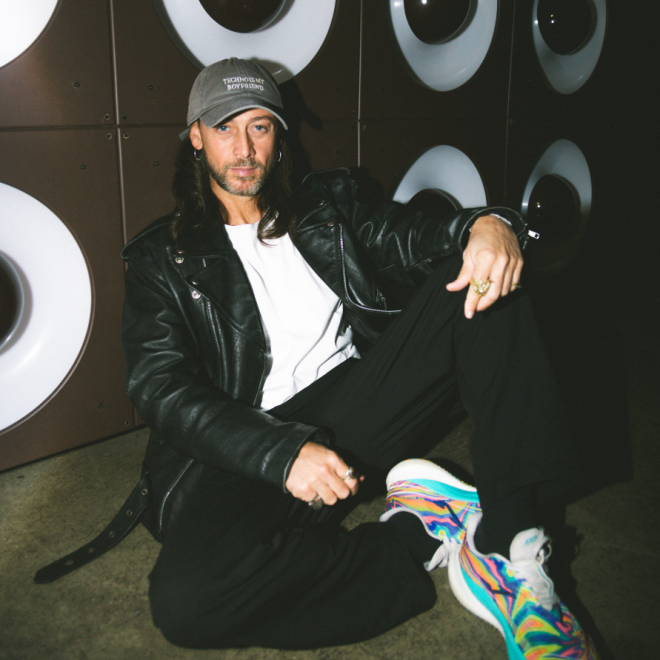
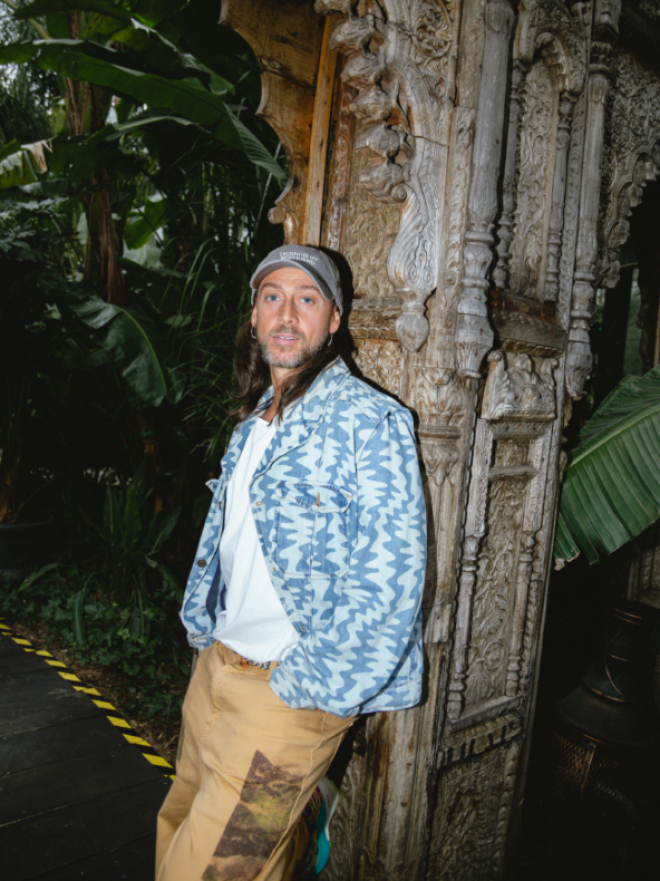
The line between being absorbed by a place and moving through it can be very thin. Glauco di Mambro, however, seems to have found the perfect balance between the two. For him, Rome’s Sanctuary is the space that initially swallowed him whole – friendships, nights, the blurring of boundaries between life and work – but that, over time, gave him back transformed. As a resident DJ and curator, he has built a career within those Roman walls that resists labels and categories, built on listening and a certain idea of the underground.
After last year’s Mixmag Lab at the Sanctuary, we met him on our pages for a conversation as fluid and clear as one of his sets. What emerged was the intimate portrait of an artist who has made independence a life choice, and movement the only form of stability he recognises.
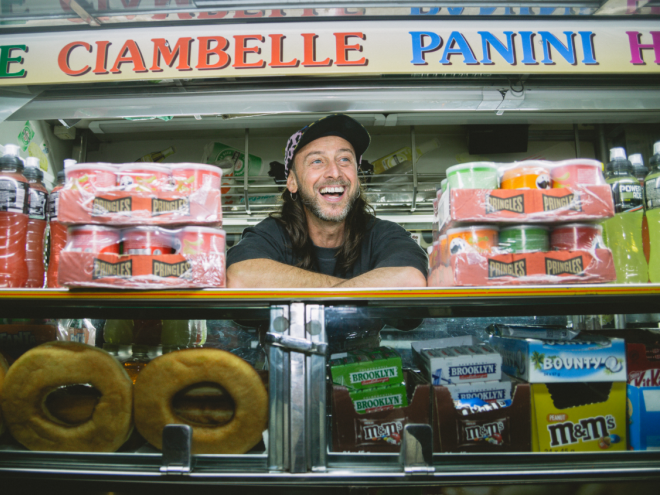
Here we are, Glauco. Let’s start where we first met: last year saw the first Mixmag Lab at the Sanctuary in Rome, which is also “your home”. What do you think changes when a global format enters such a strongly defined local ecosystem like the Sanctuary?
Hello Mixmag, and thank you for this great conversation.
First of all, let me say that The Sanctuary is above all the home of all those people who for eight years have crossed that portal and chosen to come and dance, listen to music, have dinner, do yoga, take a dip in the pool or simply relax. From Thursday to Sunday, and in summer even six days a week. It’s an incredible achievement, and I’m really happy that MIXMAG LAB chose The Sanctuary for its absolute first time in Rome inside a club.
When a player like Mixmag collaborates with a microcosm like the Sanctuary, there shouldn’t be “colonisation”, but alchemy. Over the years, the Sanctuary has managed to build an aesthetic, a sound, even very recognisable codes for its community.
For all those audiences looking for an experience beyond a simple night out, the Mixmag Lab represented validation of a journey: seeing your own “home” recognised on a global level gives you the feeling of belonging to something big, something real. It’s proof that you don’t need to be in Berlin, Ibiza or New York to be part of a globally resonant experience: quality always lies in the way you inhabit your space.
It was a clear signal that Rome’s scene isn’t a periphery, but a hub capable of hosting international standards without losing a single gram of its DNA. When a global giant adapts to such an identity-rich location, the result is a unique cultural product: less “industrial” and far more authentic.
It was also recognition for all the work done over these years: many professionals and industry insiders have passed through The Sanctuary, as is normal in our environment, but the initial core from which everything started is still here, it has never changed. And that’s a great strength.
That night, the Lab stopped being just a livestream and became part of The Sanctuary’s flow, which is so unique because it always manages to change its skin, not to follow trends but to anticipate them or even create them, while always keeping its identity crystal clear.
That’s what fascinates me and what I try to carry forward with my label and my sets: breaking down the boundaries between the local and the universal. That night with MIXMAG LAB we didn’t import a format, we exported a soul.
That night – but not only then – you were headliner, resident, curator and a representative of a scene. How do you live these roles in your daily life?
I live it as a privilege, and at the same time a responsibility to honour with all the attention, dedication and care possible.
Having the chance to give sound and concrete shape to my musical vision in a space like The Sanctuary is a unique opportunity, and I’m grateful for it. I never take it for granted, which is why I’m never satisfied and always try to give my best, to raise the bar a little higher each time.
The secret is not to live all these roles as separate, but as a single ecosystem. If you try to split them, you end up just going through the motions and losing your soul.
In my daily life, being a resident and curator means having a huge responsibility towards the walls that host me and the people who cross them. It’s not just about playing the right records, but about designing an experience, understanding the pulse of the dancefloor even before it fills up. Being a resident of a venue or an event means representing not only obviously the sound, but also the values, the identity. Inside the venue itself, but especially outside. It’s like wearing a jersey, and you have to do it with respect.
For promoters and club owners, this means reliability: they know I’m not there for a “hit and run”, but to build lasting value.
When I switch to the role of headliner, I try to carry all that underground sensitivity with me. Today’s audience is demanding, they travel a lot, they see and hear everything, they make comparisons, they have much more experience and can smell artifice from miles away. The dancefloor today demands truth. And truth lies in not being afraid to venture into acid or minimal sounds even when you could play it safe with the hit of the moment.
Daily life is very intense; you have to be able to continuously switch modes of thinking and activate all levels of intelligence: artistic, emotional, relational, but also managerial, communicative, financial.
The day is made up of many micro-moments: for two hours I’m a music selector, for two hours a composer, for two hours a producer, for another two a curator. Then again social media manager, team leader, PR, booker, art director, marketing, press, A&R… As you can see, the hours in a single day are never enough.
On social media there’s a meme going around with a pie chart representing a DJ’s life, where DJing is often just 5%, maximum 10% of the total.
It makes you smile, but also reflect, because it’s often true: which is a paradox because today infinitely more music is being produced and released than before the pandemic, so in reality you’d need even more time to dedicate to listening, selection, defining and constantly refining your sound.
Representing a scene is the aspect that gratifies me the most and challenges me the most. With STATE OF FLUX, I’m trying to shout: “Hey, you don’t have to do ‘what’s trending’ to make it work.” My daily life is made of listening, study, scouting. It’s a life choice, and living these roles together allows me to be a bridge between the underground and the sensibility of a wider audience. I’m not looking for easy consensus, I try to put music at the centre, without compromises. Because if I don’t believe in the vision I’m curating, how can I expect those dancing in front of me to?
For most people there’s work life and private life: for me – but I think for everyone who has chosen this path – there’s no difference between work and life. It’s all one flow, for better or worse: and I wouldn’t change it for anything in the world.
The Sanctuary has a very strong, almost ritual aesthetic. How much did that context shape you, and how much do you think your contribution has shaped it over the years?
Really a great question, not easy to answer: the experience with The Sanctuary, especially in the initial phase, was indescribable. There was no distinction between work, relationships, friendships, private life, relaxation: everything was fused together in a continuous creative magma and the atmosphere was really powerful, you could feel that energy with your hands. And of course that reached the people who started frequenting the location, which itself was (and still is) very iconic and distinctive. You cross that portal and enter another world, another time: all this a stone’s throw from the Colosseum, inside an archaeological park. I will never stop thanking Stefano Papa and Simone Menassè for creating The Sanctuary, and for involving me in this unique project.
The strength that gives life and shapes things inside The Sanctuary is undoubtedly theirs: I am an interpreter, but they created the perfect context for me to express myself freely.
The relationship between me and the Sanctuary has been a process of continuous osmosis. You can’t inhabit a place so dense with aesthetics and ritual without letting yourself be inspired, struck, changed.
In the beginning, that context gave me the discipline of musical storytelling. It taught me that a set is not a sequence of tracks, but a flow of energies that must harmonise with the dancefloor. The Sanctuary taught me to understand the “moment”, to wait for the crowd, to respect the silence before the beat. Thanks to The Sanctuary I learned the difference between a DJ who plays and an artist who inhabits the space.
At the same time, I believe I’ve contributed to creating and strengthening The Sanctuary’s name internationally as a reference point for a specific electronic sound with an indie soul, but with those acid and minimal nuances that have characterised a style.
The Sanctuary gave me roots, I tried to give it a musical horizon that looked beyond the boundaries of the already heard. Today I wouldn’t be this artist without those walls, but perhaps that temple would have a different sound without my journey.
At the beginning I was completely fused into The Sanctuary project. The exchange of ideas, visions, projects and initiatives was mutual and continuous: now I’m certainly more detached, both because my artistic career demands it, and because The Sanctuary has also changed a lot. We’ve all grown a lot, both in age and professionally. The Sanctuary has opened three other venues, taken on an almost corporate dimension, and I’ve grown as an artist. Almost ten years have passed since the first opening, and everything evolves in unpredictable ways, but the love remains intact. I would never have chosen any other location than The Sanctuary to build a path: that’s why my monthly residency with State Of Flux at The Sanctuary in Rome is a pillar of the whole project, and I’m really happy about that.
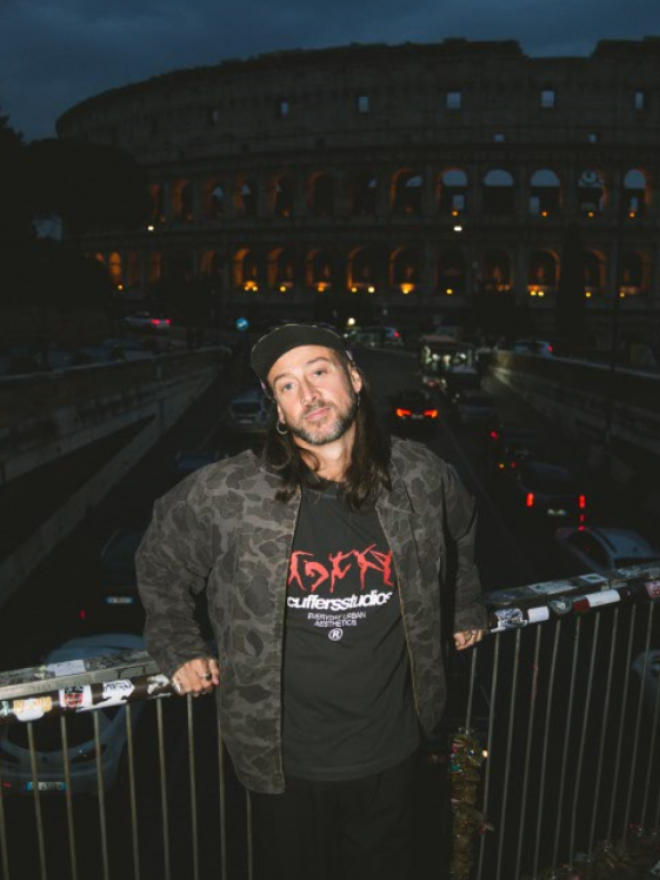
Rome is a city that over the years has never struggled to tell its story within international club culture. How do you see the city’s scene today?
Rome is a complex, visceral city that gives you nothing, but precisely for that reason has a truth that few other capitals in the world possess.
Rome is unique in many ways, and club culture is no exception: there’s an enormous amount of talent, but also a lot of arrogance at times. There’s that mix of self-satisfaction and self-pity that is so Italian, of the “I’m brilliant, but they won’t let me prove it” variety. Then who or what this enemy that puts a spoke in your wheel actually is, nobody knows, but you lull yourself in the beauty that this city gives off in every corner, and in the end you feel okay like that.
Today I see Rome in a phase of extraordinary creative reaction.
There’s a return to the underground understood as an attitude, not as a musical genre: fewer frills, fewer “tables and champagne”, and much more attention to sound culture.
For those who do my job, Rome is a constant challenge. It’s not an easy city for “copy-paste” formats: here the audience immediately understands if you’re authentic or just playing a part. The success of realities like the Sanctuary or the explosion of new collectives shows that there is room for excellence, but only if it has a soul.
I see the Roman scene today as an open-air laboratory. There’s a beautiful mix between the almost sacred aesthetic of the city and much rawer sounds. We’re emerging from the dictatorship of predefined genres to embrace a freer flow.
The scene is experiencing a fragmentation that I think is unprecedented: countless crews and micro-crews have sprung up pushing their own events, their own residents, often changing venues or even inventing them, reconverting spaces.
There are no longer those few big players monopolising the market, and I see this as a very positive thing. I perhaps miss a Rome-based radio station dedicated to electronic music that manages to establish itself internationally, but otherwise the scene seems to me to be in a very interesting moment, because we are in the middle of a reversal of trend.
The audience seems less and less interested in the big name, and clubs and promoters are no longer willing to pay those astronomical fees to headliners, or even to midliners who ultimately have a decisive impact on the event’s budget, but in the end never guarantee a return on investment. And often, they are also musically disappointing.
This is a crucial moment: if the new generation of residents and promoters take seriously this great responsibility they’ve been given, experimenting, focusing on quality and research, then we’ll witness super stimulating times.
If instead indolence prevails, and residents settle for playing the music they find in Beatport’s Top100, and promoters choose never to take risks by always booking the same 4-5 friends from their narrow circle, then this curve will last very little, and we’ll be back to square one.
I’m very curious to see what happens, and obviously I’m contributing to make the scales tip towards the first hypothesis: with STATE OF FLUX, my mission is precisely to give a home and a platform to this new energy. Rome doesn’t need to imitate anyone; it needs to rediscover its own strength in forming groups and defending its uniqueness.
State of Flux was born as a residency at the Sanctuary, but today it’s a platform that brings together events, a radio show and soon a label. How did this project come about?
State of Flux was born precisely from the need to give a clear message: the dancefloor must be a space of freedom, sharing, collective enthusiasm. Different people who don’t know each other and who together become one thing thanks to music. I want people to fall in love with that track they’ve never heard before, with that artist they didn’t even know existed, not to come with their iPhone to film the hyped DJ of the moment.
I’m really not interested in seeing a dancefloor in delirium to the notes of a track they know perfectly: what’s the point? That’s what concerts are for, for example.
Clubbing, on the other hand, must be discovery, openness, broadening one’s horizons, letting go into that state of flow where we no longer control anything, but it’s the music that controls us.
That’s where State of Flux comes from: often DJs become just collectible cards for promoters or club owners, or characters to be tagged in one’s Instagram story for the audience.
But behind every artist, if they truly are one, there is a journey, a story.
Behind every track they select there are precise choices, driven by a vision: and knowing that vision is super interesting, as well as a source of inspiration. Not only for me as an artist, but for anyone with creative sensitivity or who is simply a music enthusiast. That’s why I created the radio show attached to the event: it’s not the classic podcast where the DJ arrives and plays their mix, but a real in-depth interview. I ask my guests to choose three tracks that evoke in them that STATE OF FLUX where only the music matters: those tracks that manage to cancel out everything else and let you enter their world. We listen to each track together and comment on it, and from there we set off to discover everything about the guest: their artistic and life background, their current moment, their aspirations. Past, present and future.
And to give even more concrete form to this project, by summer I’ll also launch the label, which will become a platform for all the artists who think like me, where they can express themselves freely, without thinking about genre definitions or charts. Free music, outside the box. I already have the slogan in mind: STATE OF FLUX, a place for inspiration.
The name itself speaks of movement, instability and transformation. Is it an aesthetic or a personal statement? What “state of flux” are you in today?
You hit the nail on the head: STATE OF FLUX describes a situation of continuous change, where nothing is definitive yet. It is both an aesthetic and a personal statement.
Today we are all moving at such a speed that both external and internal conditions are constantly changing: those who seek stability are chasing an illusion and stop at appearances, ignoring the change that is now the great law governing our lives.
The only thing to do is accept the “state of flux”, dive into it and learn to find harmony in conflict and change.
Today I am fully aware of this, and that’s already a great starting point.
Musically, I’m going through a phase of great discovery: I always like to carefully build my sets, take care of the levels of tension and emotion, structure crescendos not only in terms of BPM but also energetically. To achieve this goal, the more musical languages you have at your disposal, the better, when you have full mastery of how to use them. For me, music is continuous discovery and emotion: the feeling I get when I find a track that drives me crazy during my digging hours is indescribable. It’s a beautiful thrill, one of the many reasons I love this job. Lately I’ve been moving into territories I never thought I’d explore a few years ago: the 130 BPM range, garage and breakbeat, minimal and acid house. Obviously the indie dance spirit remains, but it’s much more contaminated by house as a macro genre.
STATE OF FLUX is my acceptance of chaos as a form of order.
Aesthetically, it’s the refusal to be pigeonholed: today my music is a living organism that mutates from organic to acid, from minimal to indie dance, without ever stopping to ask permission. It’s a declaration of war on the static nature of genres. Personally, it’s the courage to embrace uncertainty. For years we have sought “stability” as a goal, but in clubbing — as in life — stability is the beginning of the end.
I can’t wait to transfer this ferment into the studio too: today I find myself in an extremely conscious, positive and creative state of flux.
I’m working on a lot of new music and soon there will be some great new things for you to hear.
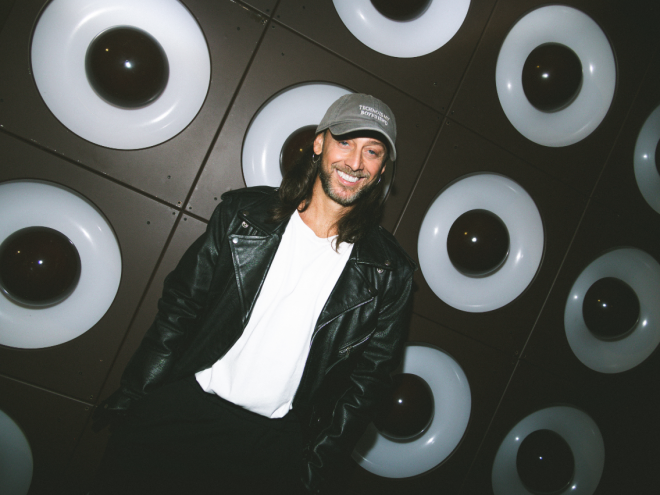
The State of Flux line-ups always have a very precise identity without ever being predictable. When you book an artist, do you look for someone who resembles you or someone who challenges you? Will you keep a similar line for the label releases?
First of all, thank you for the compliment: having a recognisable identity without being predictable is one of the nicest things you could say to me. And thank you also for the question, very focused: actually I’m looking for exactly something that surprises me, and therefore challenges me, but that can always be traced back to the sonic aesthetic of State of Flux.
I look for music rich in suggestions, with a strong energetic and emotional charge, but that never goes too dark. I look for music that is certainly sophisticated and elegant, but not too abstruse so as not to be understood by the audience. I’m absolutely not interested in genre, and for that reason all those artists who are not easily pigeonholed into a genre, but who know how to move fluidly within the ranges of an electronic music that is never banal or predictable, are more than welcome in State of Flux. And this applies both to the line-ups of the parties and to the label. Absolutely, party and label are closely connected, they are communicating vessels: the moment we invite an artist to perform at a State of Flux event, and to the radio show, for us they become part of the family. It means we share the same musical vision, the same mood and the same philosophy, inside and outside the dancefloor. So far we have done about 20 “main events” of State Of Flux, and many satellite ones, inviting around 60 international artists: well, these artists were the first I contacted to inform them about the label and to invite them to send their music. This gives you an idea of how connected label and event are for me!
If I were looking for someone who resembles me, I’d be doing an exercise in narcissism, not curation.
What I look for in an artist for STATE OF FLUX is the “offset”, that unexpected spark that forces me to look at the dancefloor from an angle I hadn’t considered. I like the idea of programming talents who have the same mental attitude as me — that hunger for independence and research — but who express a sonic language capable of challenging me. And above all of challenging the dancefloor too: today I believe predictability is the first step towards decline. The audience is too musically knowledgeable to settle for a human algorithm; they want to be surprised, they want to feel the risk.
For the label, the line will be exactly this, but with an even more visceral attention to narrative. I’m not interested in printing “functional” tracks that only serve to fill DJ sets. I look for tracks that have a backbone, that take that acid, minimal or indie dance soul into unexplored territories.
STATE OF FLUX releases must be a mirror of what we experience at the Sanctuary and at our parties: a continuous movement where identity is granite, but form is liquid. I want those who listen to one of our releases to say: “I didn’t expect it, but it’s deeply them.”
In the studio as at the console, my mission is to create a community of contrasts. If an artist challenges me, it means they’re bringing something real. And it’s exactly that “creative conflict” that turns a night or a record into an unforgettable moment.
And speaking of releases, “Ipotetica Salsa” was described as a rebellious anthem. Do you think rebellion on the dancefloor still exists today or has it become more of a narrative concept?
I really like this definition, and it’s exactly the feeling I wanted to evoke with “Ipotetica Salsa”. The term “rebellious anthem” came about because the track disregarded conventions. In a world of tracks built algorithmically to work in the first 30 seconds of a reel, proposing a sound that slows down, plays with irony and a hypnotic structure, is an act of rupture. Rebellion still exists if there is the courage to say no. No to the usual cliques that decide who should play, no to pre-packaged playlists, no to algorithms that decide our lives. “Ipotetica Salsa” is my way of saying we can also dance to the unexpected, that we can be profound without being boring and light without being trivial.
I believe that today more than ever rebellion exists on the dancefloor: it’s just that it manifests in different ways. Rebellion means not conforming to common rules, to pre-established codes: in this sense, the “No Phone Policy” dancefloor is an expression of it, for example.
Especially for the younger generation, rebellion today is turning off your phone and reclaiming physical space.
This summer I had the fortune to play twice in the Secret Apartment at UNVRS Ibiza, on Saturdays when ElRow is in the main room: there the “No Phone Policy” is really strict, it’s not just a slogan. If you don’t leave your phone outside the Apartment, you can’t enter: everyone, no exceptions. Including DJ, bartender, security. And in the Apartment I saw one of the dancefloors with the most rebellious attitude I’ve come across last summer. Even one of the key concepts behind “soft clubbing”, that of taking the dancefloor out of its pre-established context, is a rebellious act: sometimes it gets distorted and used as a pretext, but at its base there is a desire to change things, to do them differently from how they’ve been done so far. I will always be on the side of those who rebel, indeed I want to be the instigator of anyone who wants to go against the current, and that’s exactly the feeling I want to convey with my DJ sets, especially in the State Of Flux context.
For me, the dancefloor must be an open, free, shared space, where everyone feels safe to express themselves fully while respecting others, and where music expresses its greatest power, that of putting on the same level and uniting the most diverse people. On the dancefloor we are all equal, but each with their own identity to preserve: and today I don’t think there is a more rebellious act than breaking down differences, of any kind and genre. It’s not a marketing concept, it’s a biological necessity. If you lose that spark of unpredictability, the club becomes an office. And I never wanted to go to the office.
You do about 80 shows a year without an agency. Staying independent in an increasingly structured industry: is it an ideological choice or a way to stay lucid?
It’s a tough choice, it means much more extra-musical work: but fortunately I have people who support me, like Riccardo Vittore, with whom we are building an increasingly structured and close-knit team, and who are doing an incredible job.
I’m not against agencies, on the contrary: they are an integral part of a complex system like the music industry where it’s essential that everyone does their part. My musical evolution has led me to develop a very peculiar sound and language, difficult to pigeonhole: I’m aware of it, indeed I’m convinced it’s a strength, but this makes it much harder to find the right “home” at agency level.
Currently I’m in a study phase: I don’t like to change agencies often, in the past I’ve only had two in over ten years. If I enter an agency now, it must be the agency with which I will share a long journey.
I see the agency not only as a “commercial” part that helps you do more shows and sell more dates, but as a team that shares the entire journey, the entire vision of the artist. And precisely because I attribute this importance to the agency, I tend to reflect a lot before making a choice.
Especially in a context like today’s where, probably to respond to a moment of great confusion and hybridisation, agencies tend to be very sub-sectoral and focus on very specific sounds, in order to build easily interchangeable rosters. I am aware that I am not easily interchangeable and that this is the longest and hardest road, but it’s the only possible way for me.
I could never propose a sound or produce a track to meet market demands, or with the aim of being easily interchangeable with someone else: the only way for me is to stay true to my vision, it’s the only way to always feel that emotion and that charge when I’m at the console and connecting with the audience. Otherwise I would quit doing this job.
Today, at what point in your artistic journey do you feel you have arrived? What gives you the most satisfaction in your career and what are you aiming for in your future?
Today I find myself in a moment of great change and experimentation, both musically and personally. I have moved from a more organic and downtempo universe to much more Indie Dance and House sounds, with a strong acid and minimal touch. I’ve become increasingly aware that I’m not interested in pleasing the masses, but in expressing myself freely without compromises: I’ve discovered a decidedly underground soul that had remained a bit hidden.
This process of evolution has never stopped or stabilised: I feel that my sound is still in motion, and above all I feel that the time has come to give myself time to concretise this process into music. Return to the studio, produce: even at the cost of giving up some tours and doing a few fewer dates. The dream remains an Album that is the manifesto of my musical vision, but fortunately I see it less and less distant.
What gratifies me is the great freedom that this life choice allows: and I want to be clear, I believe it’s not a career, but a life choice.
I feel I have finally reached a point where I can also afford to say more “no”, to preserve my identity, to give full expression to my musical vision without compromises and without the fear or duty to please / gratify that specific scene, lobby, influential group. What matters is only the audience: they are the only ones whose judgement I accept.
I am very happy to be in a position to also help younger artists and producers take their first steps, to create a community, to provide a platform like that of the STATE OF FLUX label and events for all those who share the same vision: this is one of the things that gratifies me most, supporting and creating community.
In the future I see a lot of music, both played and produced, where all these principles are conveyed spontaneously, freshly, directly. I am strongly convinced that in this sense opening the State of Flux label is the right thing to do, and I aim to expand the State of Flux project more and more not only as a label and party, but above all as a community, with a group of artists who share this sound and spread it around the world.
It’s not just about music, the biggest goal for the future is the freedom to be vulnerable and authentic. STATE OF FLUX is not a destination, but the perimeter I have chosen to protect this purity. I prefer to go a few extra miles and sleep a few hours less, but wake up knowing that my identity is intact. I don’t seek approval, I seek connections; I no longer have the craving to build a career, but rather I want to contribute to creating an ecosystem where sound is the only compass. I can’t wait to return to the silence of the studio to give voice to a finally conscious chaos, knowing that every beat that is born will not be a compromise, but a little piece of truth to share with those who hunger for the same freedom.
